
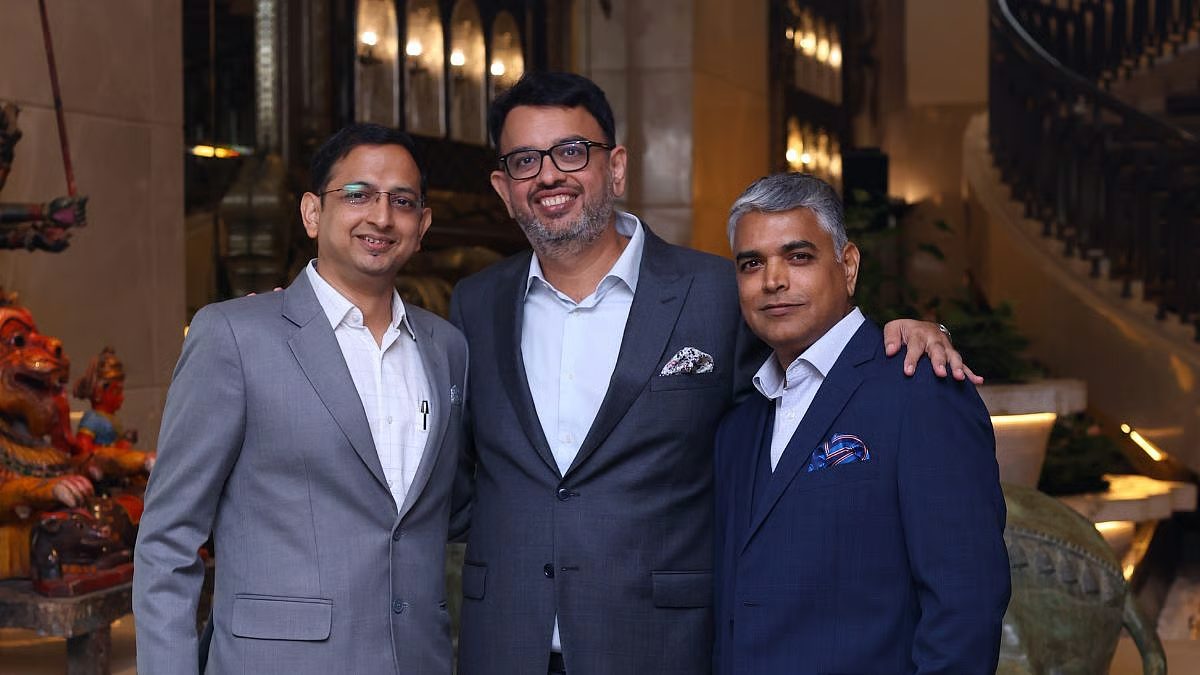
By Parth Doshi and Abhisekh Shah
Every foreign fund that buys an Indian share or family office that routes money across the border or an alternative fund that sets up shop at GIFT City – behind all of them sits a layer of the financial system that almost no one ever sees – the firms that administer the fund, clear the trades, safeguard the assets, and keep the whole machine inside the lines of the law.
For decades in India, this layer belonged almost entirely to the big banks, also the same institutions that ran asset-management desks and brokerage arms under the same roof. For a global allocator hunting a neutral, conflict-free partner, that was a tough bargain to strike.
Dovetail was built to fix this conflict.
We invested INR 100 crore in Dovetail in July 2026, the first institutional capital the company has taken since it was founded in 2017.
The Wave
Dovetail sits at the intersection of three tailwinds in Indian capital markets, each large enough on its own to justify attention.
- Retail is showing up in size. Indian mutual fund AUM has gone from ₹13.17 lakh crore in July 2015 to ₹82.22 lakh crore as of June 2026 — a six-fold expansion in a decade, with monthly SIP inflows now running north of ₹31,700 crore in June 2026. This is no longer a niche savings product; it’s becoming the default vehicle for Indian household savings, and every rupee that flows in needs to be administered, reconciled, and reported on the back end.
- Institutional capital keeps coming back. FPI flows into India are lumpy — investors pulled money out in 2018-20 and again in 2021-23 — but the pattern is consistent: every withdrawal has been followed by a larger wave of inflows. The year 2023-24 alone saw ~$40.8 billion of net FPI inflows. On the domestic side, Alternative Investment Funds (AIFs) have more than doubled in AUM over the past decade to ₹5.91 trillion, growing at a ~30% five-year CAGR, with domestic investor participation rising from 59.9% to 63.7% of the category in just the last year.
- Derivatives have gone mainstream. India is now the largest derivatives market in the world by trading volume. Monthly F&O turnover across NSE and BSE has hit roughly $0.5 trillion — about 12% of India’s nominal GDP — up from near-negligible levels in 2000. That volume has to clear somewhere, and every trade needs a clearing member standing behind it.
Layered on top of this is a structural push from the government: GIFT City has emerged as a credible onshore alternative to Singapore, Mauritius, and Dubai for structuring funds that invest into and out of India, backed by tax exemptions and a lighter compliance load. Over $20 billion has already been committed through GIFT City, with 550+ operational entities.
None of this growth requires Dovetail to win share from an incumbent to work. The pie is simply getting bigger, and Dovetail is one of the few independent platforms built specifically to service it.
The Build
What makes Dovetail interesting isn’t just that it caught a wave — it’s that it built a genuinely differentiated platform to ride it, brick by brick, since 2017.
A full stack, not a single product. Most competitors specialize in one leg of the value chain — a custodian, a clearing member, or an RTA. Dovetail built three interlocking businesses instead:
- Derivative Clearing clears ~2% of India’s daily derivative notional value — roughly $25 billion a day across ~1 million trades.
- Funds Business sets up and structures cross-jurisdictional fund vehicles (VCCs, PCCs, GIFT City entities) across India, Mauritius, Singapore, Cayman, and Bermuda, managing over $1 billion in AUA across 110+ clients.
- Fund Accounting & Administration NAV calculation, compliance, and reporting for AIFs, PMSs, and FPIs, using Advent Geneva — a system Dovetail is one of the only players in India running for this purpose.
This isn’t three unrelated businesses bolted together — it’s a single client relationship monetized three ways. A fund that sets up through Dovetail can clear its trades through Dovetail and have its books administered by Dovetail, all under one proprietary compliance system (DCMS).
A founding team that’s lived this problem. Dev Sampat, Mahesh Shekdar, and Vivek Singhania collectively bring ~60+ years from Kotak Mahindra, Standard Chartered, HDFC, and Citi Custody — the exact institutions Dovetail now competes against. The broader leadership bench (190+ combined years) includes a former SEBI Chief General Manager as Chairperson of the Investment Advisory Board, plus former AMFI/MFU and SEBI/RBL executives as independent directors. This is a team that doesn’t just understand the regulation — several of them helped write it.
The Moat
Asset servicing looks like a commodity business from the outside — until you try to compete in it. Dovetail’s durability rests on four reinforcing moats.
Regulatory scarcity. Licensing in this space is genuinely hard to get, not just paperwork-heavy. Clearing memberships, IFSCA authorizations, and multi-jurisdictional fund licenses each take months to years to secure and require real net worth commitments. Dovetail already holds licenses across India, GIFT City, Mauritius, Cayman, Bermuda, Singapore, and Dubai — a footprint that would take a well-funded competitor years to replicate.
Switching costs that compound with time. A fund cannot simply change clearing members or administrators on a whim — SEBI rules mean a client can only have one clearing member at a time, migrating fund administration means 6-12 months of data migration and regulatory risk, and the reputational cost of a botched transition is high. Industry-wide retention for specialized B2B fund services runs 85-95%. The longer a client stays, the more embedded Dovetail becomes in their operational fabric.
No conflict of interest, by design. Nearly every large clearing member in India — banks and diversified brokers alike — also runs broking, wealth management, or proprietary trading desks. Dovetail deliberately doesn’t. For institutional clients who worry about their clearing member front-running or leaking flow, that independence is itself a product feature, and reference calls with industry veterans confirmed this is a real, not theoretical, differentiator.
Proprietary technology most peers don’t have. Dovetail is one of the only firms in India using an advanced global software for fund accounting — an institutional-grade, multi-asset, multi-currency platform — paired with DCMS, its own in-house compliance management system that automates license tracking, filing deadlines, and escalation across jurisdictions. Competitors relying on manual processes or off-the-shelf tools simply can’t match the operational leverage this gives Dovetail as it scales client count without proportionally scaling headcount.
Why We Invested
Strip away the narrative and the underwriting case is straightforward:
- A market that is growing — mutual funds, AIFs, FPI flows, and derivatives volumes are all structurally expanding in India, and Dovetail doesn’t need to win a share war to grow with the tide.
- A profitable, capital-efficient business today — ₹110 Cr revenue, 49% EBITDA margins in FY25
- Real, defensible moats — regulatory scarcity, high switching costs, a no-conflict-of-interest positioning, and proprietary technology that together produce 85%+ retention in a business where clients genuinely cannot leave easily.
Dovetail is, in effect, a bet that India’s capital markets keep deepening — and that when they do, the independent infrastructure layer underneath them, not just the funds and brokers on top, is where a disproportionate share of the value gets captured.